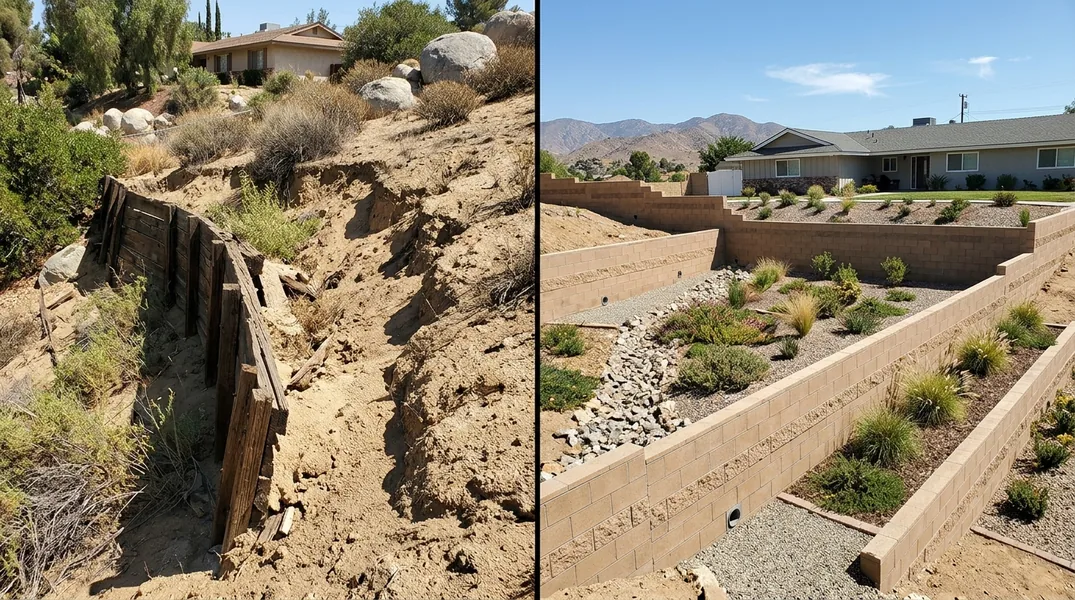
Why Decomposed Granite Soil Changes Everything for Retaining Walls
If you own a hillside lot in Riverside or anywhere across the Inland Empire, you have probably noticed that the ground under your feet is not like the soil in other parts of the country. Decomposed granite, often called DG by locals, is the crumbly, sandy, gravelly material that covers so much of our region. It drains quickly, shifts easily when it is dry, and can turn surprisingly unstable when the winter rains arrive. That combination of traits makes retaining wall design more demanding than it is in clay-heavy or loamy soils.
The biggest issue with decomposed granite is that it lacks cohesion. Unlike clay, which sticks together, DG behaves more like a pile of coarse sand and fine gravel. When you excavate a slope to build a wall, the soil behind it wants to migrate downhill. A wall that is simply stacked or set on a shallow footing will lean, settle, or bulge within a few seasons. The right material choice, paired with proper base preparation and drainage, is what keeps a wall standing straight for decades. This is why picking a material is not just a cosmetic decision. It is a structural one.
Concrete Retaining Walls: The Heavyweight Choice for Unstable Slopes
When a hillside lot has significant grade change or the soil is especially loose, Concrete Retaining Walls are often the most reliable option. Poured concrete walls are massive, and that mass is exactly what you want in decomposed granite. A properly engineered concrete wall can be designed as a cantilever or gravity structure that resists the lateral pressure of shifting soil far better than lighter materials. For tall walls, walls holding up a driveway, or walls protecting a home's foundation, concrete gives you the strength and predictability that lighter systems cannot always match.
Concrete also offers design flexibility. You can finish it with a smooth surface, a textured stamp that mimics stone, or a veneer of brick or ledgestone to soften its appearance. The tradeoff is cost and construction time. Concrete walls require formwork, curing time, and often engineered plans. For homeowners comparing options, it helps to get a clear picture of pricing before committing. If your slope is steep and the soil is loose, though, the extra investment in concrete is frequently the difference between a wall that lasts and one that needs Retaining Wall Repair within a few years.
Block and Segmental Retaining Walls: Versatile Solutions for Most Yards
For many homeowners in Corona and surrounding neighborhoods, a Retaining Wall Installation using block or segmental systems hits the sweet spot between strength and affordability. Segmental retaining walls are built from interlocking concrete blocks that rely on their own weight and a geogrid reinforcement system to hold back soil. Modern blocks come in dozens of styles, from tumbled rustic faces to clean split-face textures, so they can complement Spanish colonial, ranch, and contemporary homes alike.
The key advantage of a segmental retaining wall in decomposed granite is that it can be engineered with layers of geogrid mesh extending back into the slope. That mesh ties the wall to the soil mass behind it, which is critical when the soil itself does not hold together well. A block retaining wall also goes up faster than poured concrete, and it can be built in curves and terraces that follow the natural contour of an Inland Empire hillside. If a block wall is ever damaged, individual units can sometimes be replaced rather than rebuilding the entire structure, which makes long-term maintenance simpler.
Boulder Retaining Walls: Natural Character for Rustic Hillside Properties
Not every project calls for a manufactured product. A Moreno Valley or Jurupa Valley property with a natural, wooded, or ranch-style setting often looks best with a boulder retaining wall. Large landscape boulders set into the slope create a rugged, organic look that blends into the surrounding terrain. Beyond aesthetics, boulders are heavy and irregular, and that weight and interlocking placement can be very effective at holding back decomposed granite on lower slopes.
Boulder walls do have limits. They work best for walls under about four feet tall and for slopes that are not carrying heavy loads like a driveway or structure. The boulders must be set deep enough and backfilled correctly, or the wall will shift as the DG settles. A skilled installer will also size the boulders so the wall has a slight batter, leaning back into the hill for stability. When boulder walls are built well, they age gracefully and require very little maintenance compared to other materials.
Retaining Wall Installation Near Me: When to Call a Professional
It is tempting to look at a pile of blocks or boulders and think a retaining wall is a weekend project. In decomposed granite, that assumption can be expensive. The failure of a retaining wall is not just a cosmetic problem. A wall that gives way can send soil, debris, and even structures sliding downhill. Local building departments often require permits and engineered plans for walls above a certain height, and those requirements exist because the stakes are real. A professional installer understands soil testing, drainage, geogrid placement, and the specific behavior of DG in our climate.
If you are unsure whether your project needs a permit, or if you have an existing wall that is leaning, cracking, or bulging, it is worth getting an expert opinion early. Sometimes a wall can be saved with targeted repairs. In other cases, a full Retaining Wall Replacement is the safer path. Either way, a professional assessment protects your home, your landscape, and your budget. You can request a free estimate to get clear answers about what your slope actually needs.
Retaining Wall Installation Cost in Riverside: What to Budget
Homeowners often ask which material is cheapest, but the honest answer is that the lowest upfront price is not always the lowest total cost. A boulder wall may cost less per square foot than poured concrete, but it may not be suitable for a tall slope, which means it is not really an option at any price. A block wall is usually more affordable than concrete and works for most residential grades, while concrete tends to be the highest investment because of engineering, formwork, and curing time. In decomposed granite, every material requires proper excavation and a compacted base, and those preparation costs are a significant part of any project.
Budget also needs to account for drainage. French drains, weep holes, and gravel backfill are not optional extras in our soil. They are what prevent water pressure from pushing a wall over during the rainy season. When you compare bids, make sure each one includes drainage, compaction, and hauling. For a realistic range based on your slope and material choice, check the company's pricing page or call Riverside Retaining Wall at (951) 425-4346. A short conversation about your hillside lot can save you from an expensive mistake and point you toward the material that will actually perform.
Looking for a professional retaining wall contractor in Riverside? Riverside Retaining Wall responds fast for all your retaining wall needs.
Get a Free QuoteOur services: Retaining Wall Installation · Retaining Wall Repair · Retaining Wall Replacement