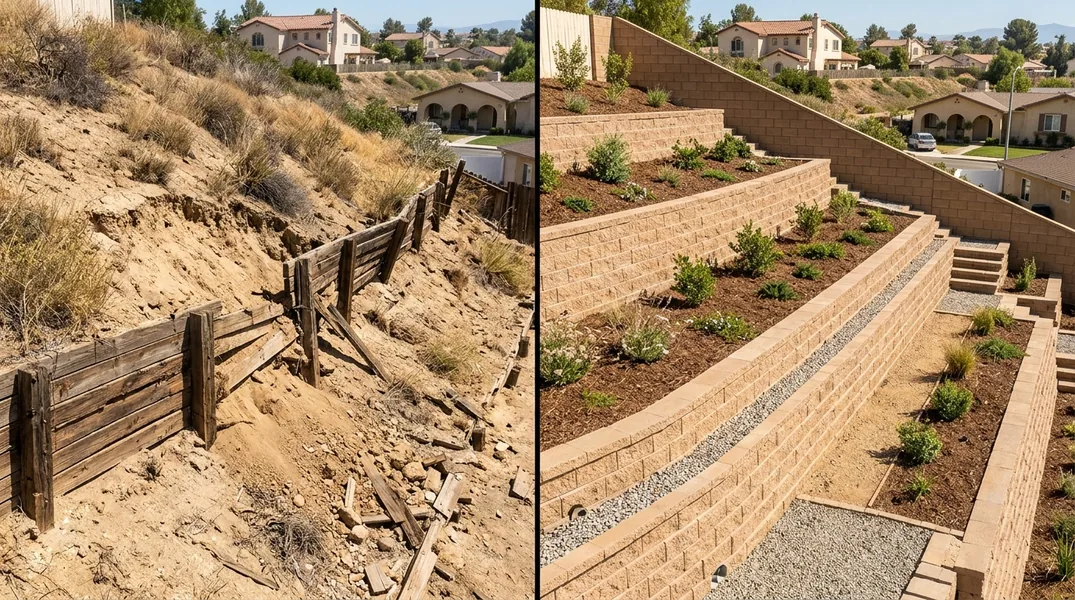
Why Inland Empire Winter Storms Are Hard on Retaining Walls
Inland Empire winters are not just a little rain. When storms roll in from the Pacific, they can drop several inches of water in a short time, and the ground in Riverside often cannot absorb it fast enough. That water has to go somewhere, and all too often it goes straight into the soil behind a retaining wall. What many homeowners do not realize is that a retaining wall is designed to hold back soil, not to act as a dam. When water builds up behind the wall, it creates hydrostatic pressure, which is one of the most common causes of wall failure in our region.
The problem is compounded by the fact that many older walls in Corona and Moreno Valley were built without proper drainage. Even walls that were originally well built can lose their drainage capacity over time as soil fines clog the gravel and filter fabric. Once that happens, the wall is essentially sitting in a bathtub every time it rains. The result can be bulging, cracking, leaning, or even a sudden collapse after a particularly heavy storm.
How Hydrostatic Pressure Builds Up Behind a Wall
Hydrostatic pressure is the force exerted by water that is trapped and unable to drain. Behind a retaining wall, this pressure increases with depth, meaning the bottom of the wall takes the brunt of it. When the soil behind the wall becomes saturated, it gains weight and loses shear strength. The water pushes outward against the wall, and the soil pushes with it. A wall that was perfectly stable in dry conditions can fail quickly once that pressure builds.
This is why retaining wall drainage is not a luxury, it is a structural necessity. A properly designed wall includes a French drain, also called a drain tile, at the base. This is a perforated pipe set in a bed of washed gravel and wrapped in filter fabric. The pipe collects water and carries it away from the wall. Without it, or if it becomes clogged, water has nowhere to go but through or against the wall. In many cases, the first sign of trouble is water seeping through the face of the wall or muddy soil at the base after a storm. If you notice these signs, it is worth calling a professional for an inspection before the next storm hits.
The Role of a Retaining Wall French Drain
A retaining wall French drain is the most reliable way to manage water behind a wall. It typically consists of a perforated PVC pipe, gravel, and a filter fabric that keeps soil from clogging the system. The pipe is sloped so that water flows to an outlet, either at the surface or to a storm drain. In some cases, a dry well or a pop-up emitter is used to disperse the water safely away from the wall. The key is that water must be able to move out from behind the wall as fast as it enters.
Unfortunately, many failed walls in Jurupa Valley and across Riverside were built with no French drain at all, or with a system that was poorly designed. Some contractors skip the gravel and fabric, or they use the wrong type of pipe. Others fail to provide a proper outlet, so the pipe fills up and becomes useless. When we perform a Retaining Wall Repair, one of the first things we check is the drainage system. If it is inadequate, we often need to retrofit a new drain to prevent future failures.
Warning Signs of Drainage Failure in Your Retaining Wall
Homeowners should watch for several red flags that indicate drainage problems. Bulging or leaning is one of the most obvious signs. If the wall is no longer straight, it means pressure has already moved it. Cracks, especially horizontal cracks, are another warning. Water seeping through the face of the wall or muddy water at the base after rain is a sign that the drain is not working. Soggy soil at the top of the wall or water pooling behind it also points to poor drainage.
Do not ignore these signs. A small crack or a slight lean can quickly become a major failure during the next winter storm. In some cases, a wall that looks fine on the surface can be slowly deteriorating due to clogged drainage. If you are unsure, a professional inspection can save you thousands of dollars in repairs. We offer a free estimate for any drainage or wall issue. You can also call us at (951) 425-4346 to schedule a consultation.
Retaining Wall Installation Near Me: When to Call a Pro
If your wall is showing signs of drainage failure, or if you are planning a new wall, it is best to call a professional. Proper Retaining Wall Installation involves more than stacking blocks or pouring concrete. It requires an understanding of soil conditions, water flow, and local building codes. A wall that is not designed for the site can fail prematurely, even if it looks good at first. We design and build walls that handle Inland Empire stormwater properly, with French drains, gravel, and proper backfill.
If your existing wall is beyond repair, we also offer Retaining Wall Replacement. Sometimes the most cost-effective solution is to replace a failed wall with a new one that includes modern drainage. For homeowners who prefer a durable, low-maintenance option, Concrete Retaining Walls can be an excellent choice when properly drained. We also provide clear pricing so you know what to expect before we start. If you need help, contact us at (951) 425-4346 or visit our website to learn more.
Protecting Your Wall Before the Next Storm
Prevention is always better than repair. If your wall is older or you are unsure about its drainage, schedule an inspection before the rainy season. Simple steps like clearing debris from the outlet of the French drain, ensuring that downspouts and surface water are directed away from the wall, and avoiding planting large trees too close to the wall can help. However, if the drain is clogged or nonexistent, no amount of surface maintenance will fix the underlying problem.
In Riverside, we see many walls that have survived for years but are now on the brink of failure due to neglected drainage. The cost of repairing or replacing a failed wall is far higher than the cost of a proper drainage retrofit. If you are concerned about your wall, do not wait until the next storm. Call Riverside Retaining Wall at (951) 425-4346 or request a free estimate online. We serve Riverside and the surrounding areas, and we can help you protect your property from water damage.
Looking for a professional retaining wall contractor in Riverside? Riverside Retaining Wall responds fast for all your retaining wall needs.
Get a Free QuoteOur services: Retaining Wall Installation · Retaining Wall Repair · Retaining Wall Replacement